Loan Settlement Scenario Calculator
Explore how a hypothetical settlement amount fits your monthly budget and understand the savings effort involved.
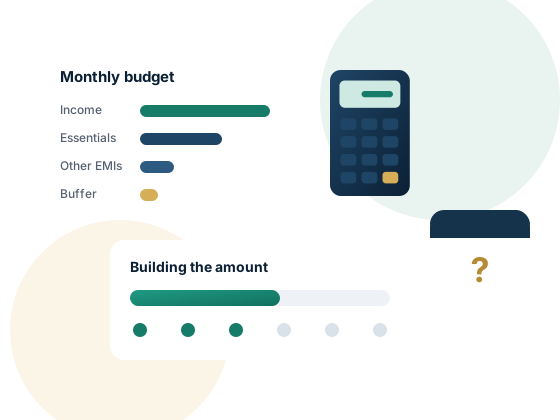
Your snapshot
Your results will appear here as you type.
Enter a hypothetical amount to see this
Important: This calculator is for educational and illustrative purposes only. It does not predict whether a lender will approve a settlement, the amount a lender may accept, or the time required to resolve an account. Any actual settlement depends on the lender's decision and individual circumstances. Do not stop repayments, ignore notices or make financial decisions based only on this calculator. Consider obtaining independent professional advice.
A settled loan is usually reported as "Settled" on your credit report, which can make future borrowing harder for several years.
Want to understand your available options?
Every borrower's situation is different. Discuss your circumstances with our team for case-specific guidance.
Starting a consultation does not share any figures you entered here.
What this calculator does
It helps you look at one question calmly: if you were to explore a settlement, could your monthly budget realistically build the amount, and how long might that take? You enter your own figures, including any hypothetical amount you want to test. The calculator then shows how much your budget leaves each month and how long saving the remaining amount would take at that pace.
It does not suggest a settlement amount or percentage. There is no standard figure that banks or NBFCs accept.
How the calculations work
| Result | How it is calculated |
|---|---|
| Estimated monthly capacity | Monthly income − essential expenses − other commitments − safety buffer. If this is negative, it is shown as zero. |
| Remaining amount to build | Hypothetical amount − existing savings, never below zero. |
| Illustrative time to build it | Remaining amount ÷ monthly capacity, rounded up to whole months. Shown only when monthly capacity is above zero. |
| Difference in your hypothetical scenario | Outstanding amount − hypothetical amount. Shown only when the hypothetical amount is not more than the outstanding amount. |
The calculator assumes your income and expenses stay the same each month. Real budgets change, and interest or charges on the loan may keep adding up while you save.
What it cannot predict
- Whether your lender will agree to settle at all — settlement is never a right.
- The amount a lender may accept, or whether it will accept payment in instalments.
- How long a lender takes to decide, or how your account balance will change while you save.
- The effect on your credit report beyond the general point that a settled account is reported as "Settled".
What affects a lender's actual decision
Under the RBI's Framework for Compromise Settlements and Technical Write-offs (8 June 2023), banks and NBFCs settle accounts under their own board-approved policies. In practice a lender will usually look at:
- its own policy and approval process;
- how long the account has been overdue and the amount involved;
- any security or guarantee linked to the loan;
- your documented circumstances, such as a job loss or medical costs;
- whether you can pay a lump sum, and by when.
Under the same framework, a settlement paid over more than three months is treated by the lender as a restructuring, and the lender that settles with you must wait at least 12 months (for non-farm loans) before lending to you again.
Risks of loan settlement
- A "Settled" status can make loans and credit cards harder to get for several years.
- Interest and charges usually keep building until an agreement is reached.
- The lender may continue recovery or legal steps while you save or negotiate.
- Missing EMIs on purpose to "qualify" for settlement adds charges and harms your credit report.
- Pay only into the lender's official account, and only against a written settlement letter.
Other options to explore
- Restructuring: a lower EMI or longer tenure if you can still pay something each month. See settlement vs restructuring.
- Talking to your lender early: before an account falls far behind, lenders may have more options.
- Debt consolidation: only if your credit is still good enough for a cheaper loan. See consolidation vs settlement.
- Getting help with several loans: list every loan and decide what to tackle first. See what to do if you can't pay your EMI.
Frequently asked questions
No. It only shows how a figure you choose fits your own budget. Lenders decide under their own policies and your circumstances, and no calculator can predict that.
Because no universal percentage exists. Suggesting one would be misleading and could lead to unrealistic expectations or poor decisions.
No. Everything is calculated in your browser. The figures are not sent to us, not stored on your device by this page, not added to the web address, and not shared with analytics or advertising services. Refreshing the page clears them.
An amount you want to keep aside each month for emergencies such as medical costs or repairs. Keeping a buffer makes any plan more realistic.
Speak to your lender early about your situation and ask about options such as restructuring. You can also talk to us in confidence about what may be possible in your case.
No. Stopping payments on purpose adds interest and charges, harms your credit report and can lead to recovery action. Settlement is meant for genuine hardship.
Usually yes. The account is reported as "Settled", which lenders treat as a negative mark. See credit report guidance.
Sources
- Reserve Bank of India — Framework for Compromise Settlements and Technical Write-offs, 8 June 2023: rbi.org.in