Recovery Agent Harassment Support
Know what recovery agents are allowed to do, record what is happening, and raise breaches with the lender, the RBI Ombudsman or the police.
Short answer
Lenders may recover overdue loans, but RBI rules forbid threats, abuse, public shaming and harassing your family, friends or colleagues. From 1 January 2027, agents of banks and NBFCs may contact you only between 8 a.m. and 7 p.m. and must carry ID and an authorisation letter. Record breaches, complain in writing to the lender, then escalate to the RBI Ombudsman.
The rules recovery agents must follow
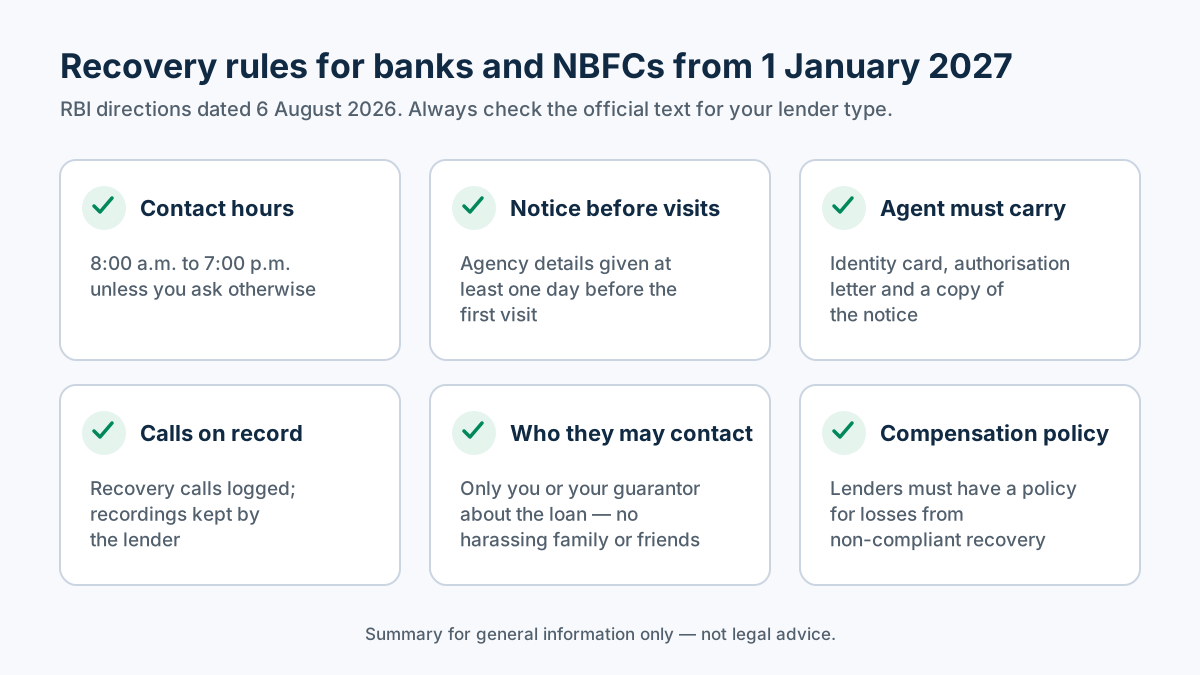
The lender is responsible for the agents it uses. On 6 August 2026 the RBI issued detailed directions on recovery for banks (RBI/2026-27/223) and NBFCs (RBI/2026-27/230), which take effect on 1 January 2027. Among other things, they require that:
- Agents contact or visit you only between 08:00 and 19:00, unless you have asked for a different time, and respect a request to avoid a particular time.
- The lender tells you the recovery agency's details at least one day before its first visit, and tells you immediately if the agency changes.
- Agents show an identity card and carry an authorisation letter and a copy of that notice, which must include the phone number of the lender's grievance redressal officer.
- Agents discuss the loan only with you or your guarantor, behave civilly, and avoid occasions such as a bereavement, medical emergency or wedding.
- The lender logs the time and number of recovery calls and keeps recordings for six months.
- The lender's recovery policy includes compensation for losses caused by recovery actions that break the directions.
What agents must never do
The directions list practices that are not allowed, including:
- Using threatening or abusive language
- Posting your recordings or personal details on social media
- Calling or messaging excessively, or outside the permitted hours
- Intimidating or harassing your relatives, referees, friends or co-workers, or humiliating you publicly
- Using or threatening violence against you, your family, your property or your reputation
- Making false or misleading statements about how much you owe or what will happen if you do not pay
Who this helps
- Borrowers receiving repeated, abusive or late-night recovery calls.
- People whose family, employer or neighbours are being contacted.
- Anyone visited by agents who will not show identification or authorisation.
Limitations
- A complaint about harassment does not cancel the debt. Lenders can still recover lawfully, including through courts or arbitration.
- We cannot promise that calls will stop. We help you use the rules properly and escalate where they are broken.
- If you are threatened with violence, go to the police immediately — do not wait for a lender's reply.
How we help
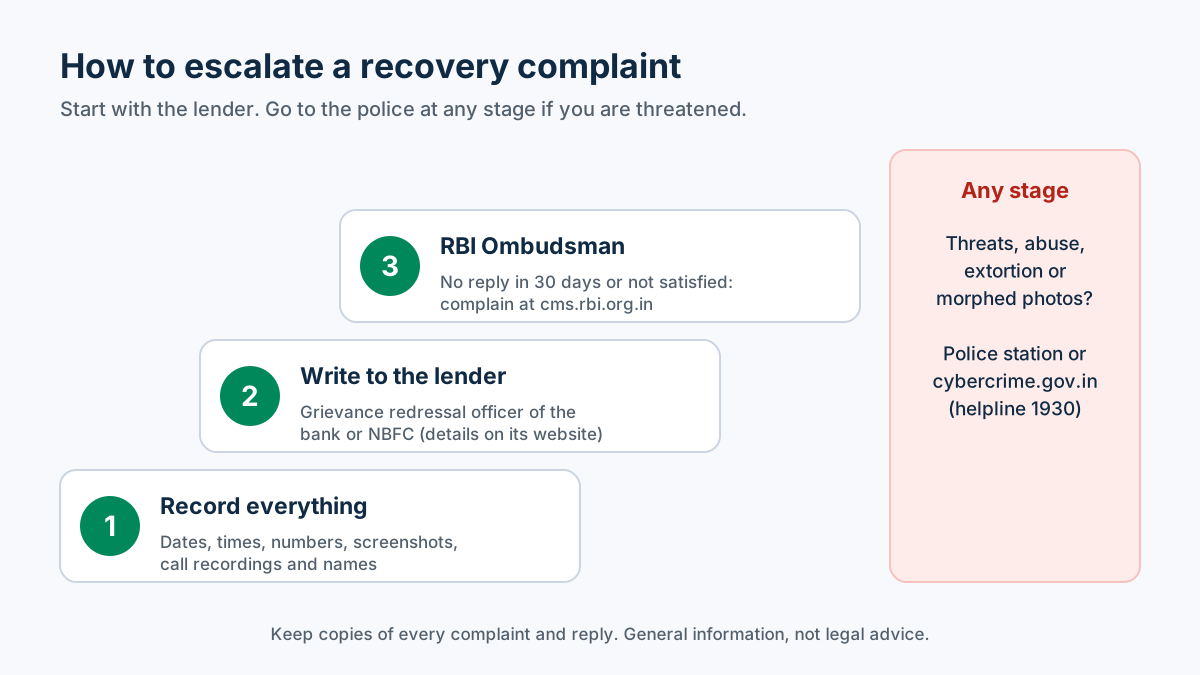
- Understand what is happeningWe listen, identify the lender and agency, and check which rules may have been broken.
- Build an evidence logWe help you record dates, times, numbers, names, screenshots and recordings in one place.
- Write to the lenderWe help you draft a clear complaint to the grievance redressal officer, asking for the agency's details and for the conduct to stop.
- EscalateIf there is no reply in 30 days or the reply is unsatisfactory, we guide you through an RBI Ombudsman complaint, and to the police where needed.
- Deal with the debtWhere you are ready, we help you work towards a settlement or restructuring so the pressure ends for good.
Evidence to keep
- A log of every call and visit: date, time, number, name and what was said
- Screenshots of messages, and call recordings where you have them
- Names of anyone else who was contacted, and what they were told
- Copies of any notice, ID or authorisation letter shown to you
- Copies of your complaints and the lender's replies
Before and from 1 January 2027
| Topic | Until 31 December 2026 | From 1 January 2027 |
|---|---|---|
| Calling and visiting hours | 08:00–19:00 under existing RBI instructions | 08:00–19:00, now set out in detailed directions with exceptions only at your request |
| Notice before a visit | Lenders to share the agency's details with you | Agency details at least one day before the first visit |
| Agent identification | Authorisation required | ID card, authorisation letter and a copy of the notice, with grievance officer's number |
| Call records | Not set out in the same detail | Calls logged; recordings kept for six months |
| Compensation | Not set out in the same detail | Recovery policy must provide for compensation for non-compliant actions |
Simplified summary. Read what changes in 2027 and the official RBI directions.
Frequently asked questions
Between 8:00 a.m. and 7:00 p.m. From 1 January 2027 this is set out in the RBI's recovery directions for banks and NBFCs, and calls or visits outside these hours are allowed only if you have asked for them.
Agents should ordinarily meet you at a place of your choice. If you have not chosen one, or do not turn up twice in a row, they may contact you at home or at your workplace. From 1 January 2027 the lender must tell you the agency's details at least a day before the first visit.
Agents must discuss your loan only with you or your guarantor, and intimidating or harassing your relatives, referees, friends or co-workers is prohibited. Record any such contact and include it in your complaint.
Ask to see their identity card and authorisation letter, and note their name, agency and the lender's grievance officer number. Stay calm, do not sign anything you have not read, and pay only through the lender's official channels against a receipt.
Write to the lender's grievance redressal officer first. If there is no reply within 30 days, or you are not satisfied, file a complaint with the RBI Ombudsman at cms.rbi.org.in within 90 days. Read how to file an RBI complaint.
Immediately if you are threatened with violence, extortion or the publication of your photos or personal details. Online threats can also be reported at cybercrime.gov.in or on the helpline 1930.
No. You can complain about unfair recovery and still negotiate a settlement or restructuring. Often, dealing with the debt is what ends the pressure for good.
Sources
- RBI (Commercial Banks – Responsible Business Conduct) Fourth Amendment Directions, 2026 — RBI/2026-27/223, 6 August 2026: rbi.org.in
- Corresponding directions for NBFCs — RBI/2026-27/230, 6 August 2026: rbi.org.in
- Reserve Bank – Integrated Ombudsman Scheme, 2026: rbi.org.in · Complaint portal: cms.rbi.org.in
- National Cyber Crime Reporting Portal: cybercrime.gov.in